What is a news trade, and why do some headlines keep moving?
A news trade is a stock that starts moving because of a fresh, public headline: a signed deal, a regulator’s decision, quarterly results, a large contract. The trade is the move that follows, once enough traders have read the story to keep buying, and it rarely starts on the first print.
A headline does not reach everyone at once. Machines reading the wires get there first, then traders watching a news feed, then everyone who finds the stock on a gainers list.
How many people see a story sets the size of the move: Bloomberg terminal articles placed on the front page drew “240% higher trading volume and 176% larger absolute excess returns” in their first 10 minutes than equally important articles placed elsewhere, and were fully priced within about an hour (Fedyk, 2024). The late arrivals are mostly individuals, who “are net buyers of attention-grabbing stocks” (Barber and Odean, 2008). The last buyer is usually the one the first buyers sell to.
Not every headline move holds. Large moves that came with real information “are followed by drift”, and moves without it tend to reverse (Savor, 2012; Chan, 2003). Stale news, a reprint of a story the market already had, still gets traded on the day, and that move tends to reverse the following week (Tetlock, 2011). These studies run over days and months, so they are a filter, not an entry rule: follow moves with something new and material behind them.
So the edge is picking the right headline and trading the second move: let the first spike pull back, check that the pullback held most of it, and buy the next push with a stop under the pullback. The headline tells you which stock; the pullback tells you whether buyers are still there.
How do you find stocks moving on breaking news?
You need a short list of stocks that have a fresh headline and are moving now, and the headline itself one click away. In Scanz the first is a Data Scanner template, Moving on News NOW, and the second is the News Scanner. These are the template’s rules exactly as Discover stores them.
The scan · Data Scanner · From 9:30 ET
Moving on News NOW
| Rule | Setting | Why it's there |
|---|---|---|
| News Count (1h) | ≥ 1 | At least one headline for the ticker in the last hour. The window can be set from 1 minute to 4 hours. |
| % Change (last 15m, extended hours) | ≥ 2 | Moving now. A stock that jumped at 8:00 and went quiet drops off. |
| RVOL (20-day avg, regular hours) | ≥ 2 | Twice its usual volume: the headline has brought in new traders. It counts regular-hours trading only, so the scan lists nothing before 9:30 ET; the pre-market copy below changes that one setting. |
| Volume (Full Session) | ≥ 100,000 | Enough shares, pre-market included, that the price on screen is one you could trade near. |
The scan joins two facts by time: a headline was published for the ticker in the window, and the stock is moving now. It does not read the headline and cannot tell you the headline caused the move. That check is yours.
The trial is 7 days of Pro, card required. It becomes Pro at $199/month after day 7 unless you cancel in the app. Starter ($89/month) includes the Data Scanner and the News Scanner with real-time news, but runs one scan at a time, so this scan beside a news scan with a sound needs Pro.
Before 9:30 the template lists nothing. Its Relative Volume rule counts regular-hours trading only: the badge reads RH, with a red clock beside it. On November 6, 2026 the template listed no stocks in 12 reads between 8:11 and 8:19 am ET, with the pre-market under way. The rule’s Session setting is the fix, tested the same morning below.
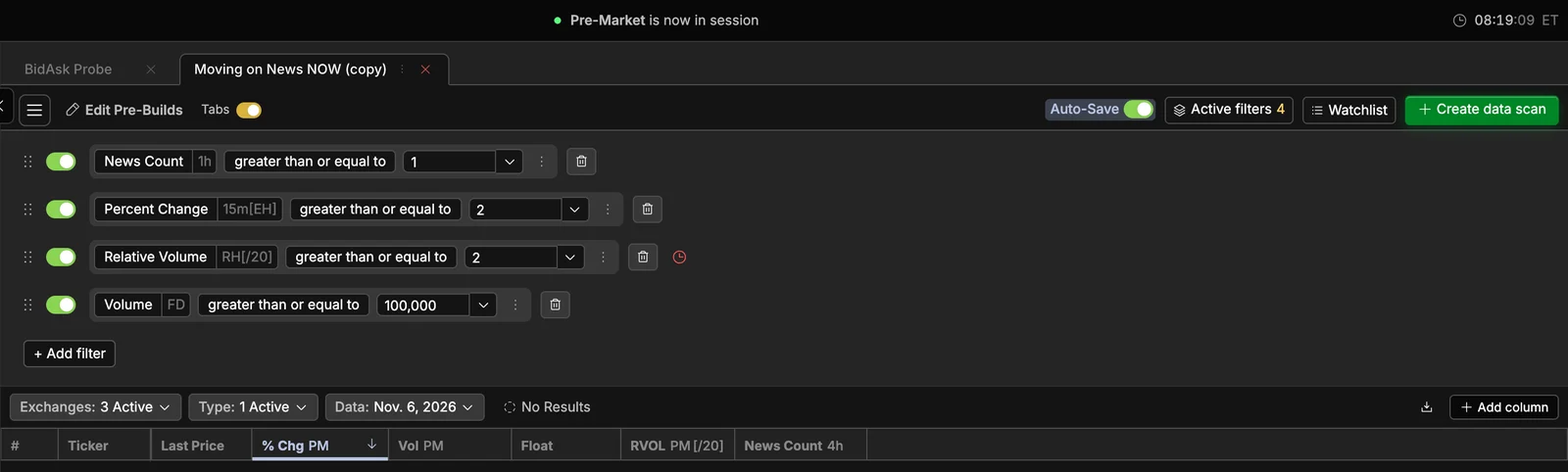
The pre-market copy. Copy the template, open its Relative Volume rule and set Session to Pre-Market. Data Interval stays Daily and N stays 20; the badge changes to PM and the red clock goes away.
The scan · Data Scanner · 4:00 to 9:30 am ET
Moving on News NOW, pre-market copy
| Rule | Setting | Why it's there |
|---|---|---|
| News Count (1h) | ≥ 1 | Unchanged: a headline for the ticker in the last hour. |
| % Change (last 15m, extended hours) | ≥ 2 | Unchanged: this rule already counts pre-market trading. |
| RVOL (20-day avg, pre-market) | ≥ 2 | The one change: today's pre-market volume against the average of the last 20 pre-markets. |
| Volume (Full Session) | ≥ 100,000 | Unchanged: shares from 4:00 am. |
On November 6, 2026 this copy listed four stocks in 66 reads between 8:29 and 9:15 am ET. Set it back to Regular Hours, or switch to the template, at 9:30.
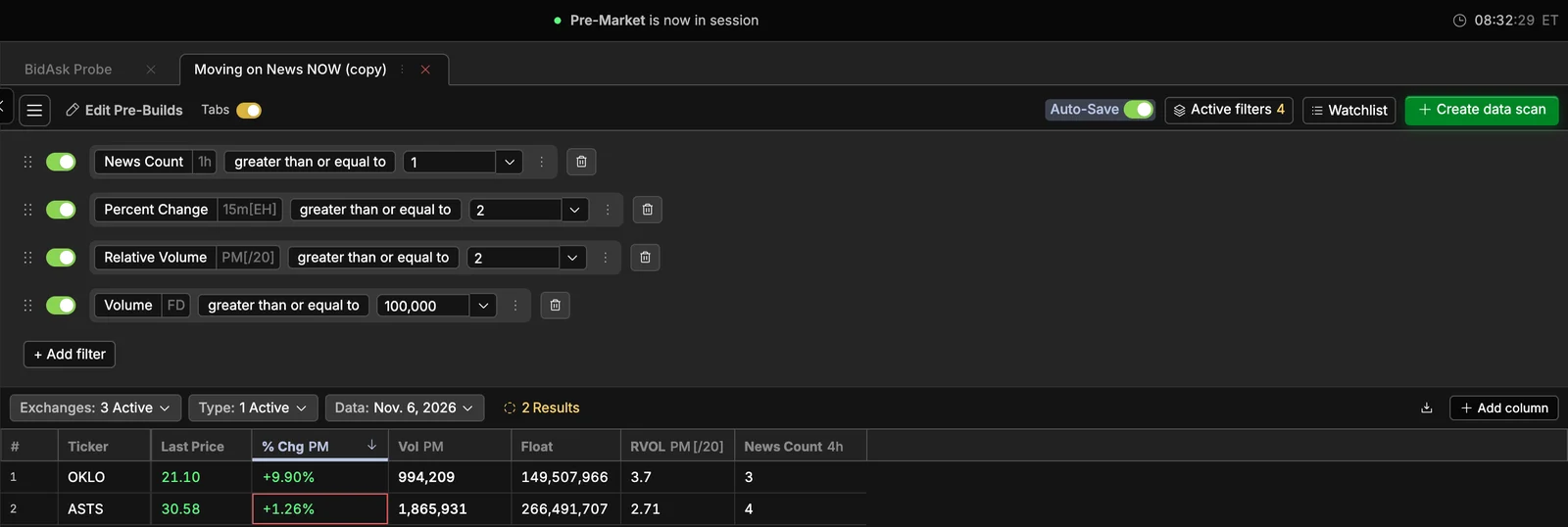
The four stocks show what the list is and is not. ZENA was listed at 8:39, nine minutes after a contract release at 8:30. OKLO was listed at 8:32, up 9.9%, after quarterly results at 7:30. WHLR was listed 24 times from 8:43 with nothing newer in the News Scanner than results the evening before. And ASTS was listed at 8:29:29, half a minute before its 7:30 company releases turned an hour old: a rocket built with Firefly Aerospace engines, in a deal Firefly valued at more than $1.3 billion.
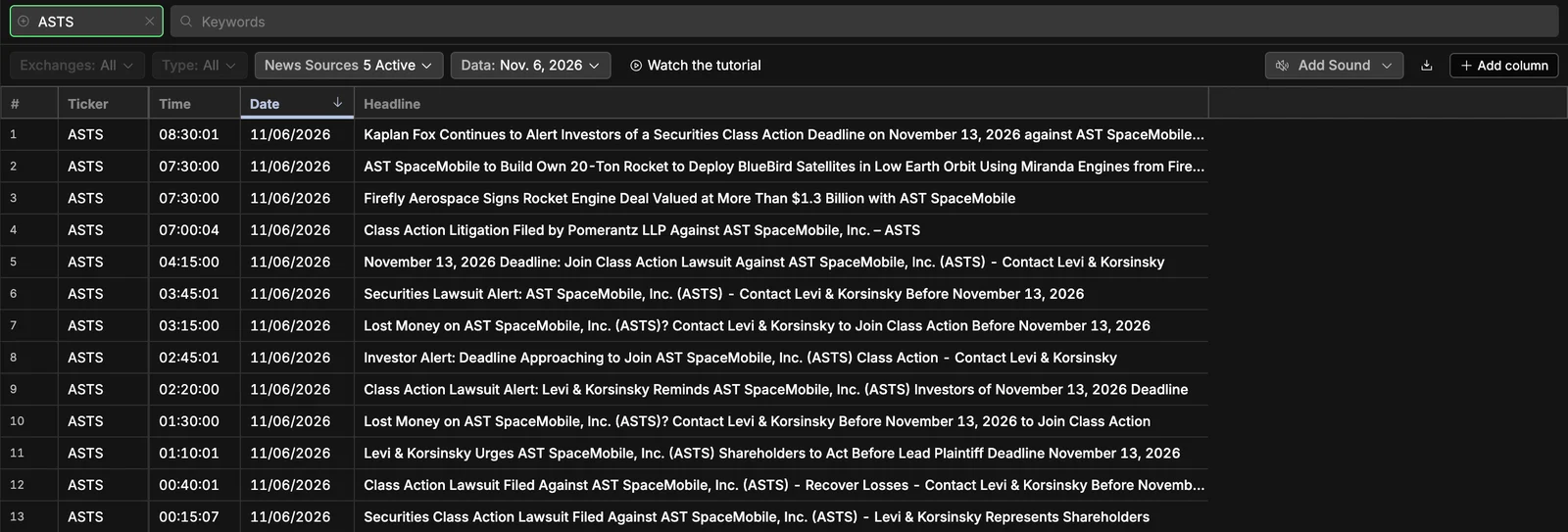
From 8:30 the headline inside ASTS’s 1-hour window was not the rocket deal but a law-firm notice at 8:30:01, one of eleven that morning. News Count counts headlines; it cannot tell a $1.3 billion contract from a class-action reminder, and a stock with a lawsuit in progress gets several a day. That is why the headline is read before the chart, on this copy and on the template.
Headlines before the open. Three of the five headlines in the examples below came out between 4:00 and 8:01 am; companies tend to publish results and deals outside market hours. At 9:30 an 8:01 headline is more than an hour old, so News Count (1h) drops the stock just as regular-session volume arrives. For the open, copy the template and widen the window to 2, 3 or 4 hours; set it back to 1 hour by mid-morning (filter reference).
The % Change rule counts only stocks going up; a second copy at −2% or lower watches for bad news.
Your scan set, by time of day.
| When (ET) | Run | The setting that differs |
|---|---|---|
| 4:00 to 9:30 am | The pre-market copy | Relative Volume Session: Pre-Market |
| 9:30 to mid-morning | The template | News Count widened to 2 to 4 hours, so a pre-market headline stays listed |
| Mid-morning to 3:30 pm | The template as stored | News Count 1 hour |
| Any time, for bad news | A copy of the template | % Change −2% or lower |
| All session | The offerings-and-warrants news scan | A sound on; its rules are under the exit rules below |
| All session | The News Scanner | News and Filing on; Web News and Promo off |
Starter saves one Data scan and runs one scan at a time, so the full set needs Pro; the trial is 7 days of Pro.
Which headlines are worth trading?
Read the headline before the chart. Four questions sort most of them: is it new, is it material, who published it, and does it sell shares?
Reading the headline. The News Scanner streams headlines in real time from SEC filings and five press-release wires: Newsfile, PR Newswire, Globe Newswire, AccessWire and BusinessWire. Filings come from EDGAR with a short delay, and Scanz does not publish a guaranteed latency figure (News guide). The News Type selector in the toolbar sets which categories appear: News, Filing, Web News and Promo. For this setup keep News and Filing, and leave Web News and Promo off so blog posts and paid promotions stay out of the list.
Double-click a row for the article, the chart, or both, with buttons to set an alert (Pro), hide the story or open the Montage. Search by ticker shows a stock’s headline history over weeks, which is how you check whether this morning’s story is new. Scanz has no analyst-ratings feed; its Upgrades and Downgrades templates in Discover match headline keywords.

Ready-made news scans. Discover’s News Scanner section has keyword templates: Earnings (earnings, weak, beat, expectations), FDA & Drugs (fda, drug, approval, clearance, phase 3), M&A / Buyouts (merger, acquisition and their forms, excluding “emerg” and “acquisition corp”), and Dilution Watch (filings only: S-1, S-3, S-4, Form D, Form 144). A keyword matches anywhere in a headline, ignores case, and any one is enough; a minus sign excludes a word; there is no AND. The one to build for this setup, set out under the exit rules below, warns you when a stock you hold starts selling shares.
| Headline | What usually follows | What to check |
|---|---|---|
| Signed merger or acquisition | The target jumps toward the deal price; the buyer can go either way | Which side your ticker is on; cash or stock |
| A regulator’s decision | A one-time repricing, often large | Decision or step? “Productive meeting” and “plans to file” are steps |
| Results and guidance | Depends on expectations the headline does not state | The guidance line, not the title |
| Contract, partnership, “cooperation agreement” | Small companies move most when the title carries a big number | Is the other party named? Is the amount firm, or “at least” and “up to”? |
| Offering, warrant deal, at-the-market program | Down | Size against the float, and the price |
| Recap, reprint, promotion | Fades | Search by ticker: is it last month’s story again? |
| Law-firm “investigation” or class-action notice | Usually nothing, but it counts as a headline: ASTS had eleven before 8:30 am on November 6, 2026 | Exclude it with keywords |
| A filing with no release | Anything | Open it; it may describe news the market already had |
An 8-K can arrive days after the press release: companies generally have four business days to file one after a reportable event. And some catalysts never reach the feed: analyst calls, and stories from outlets that are not press-release wires. KXIN was up about 10% at 1:26 pm ET on November 5 with no headline in the feed since September 16. That is a mover, not a news trade.
What are the entry, stop and exit rules?
The setup on one card
- Time window
- From the headline to 60 minutes after it. A pre-market headline gets a second window, 9:30 to 10:00 am ET. No new trades after 3:30 pm.
- The headline
- New today, material, from the company or the SEC, and not selling shares
- Participation
- At least 100,000 shares since the headline. A pre-market move on fewer shares is not a price yet.
- Setup
- The spike runs from the last trade before the headline to its high: the top of the last 5-minute bar before one fails to make a new high. In the 9:30 to 10:00 window it runs from the 9:30 open instead, a choice tested on two trades below. The pullback that follows must hold above the spike's midpoint.
- Entry
- A cent above the previous bar's high, on the first 5-minute bar that takes it out after the pullback
- Stop
- A cent under the pullback's low. It stays there until the first target.
- First target
- 1R, the entry-to-stop distance added above the entry. Take half off.
- The rest
- Once half is off, trail the stop a cent under each higher 5-minute low. Exit at once on a headline that sells shares.
- Skip it when
- The pullback loses the midpoint; the headline is a recap, promotion or law-firm notice; the spread is more than a tenth of the risk; the stock is being halted
Why the pullback. The first prints after a headline are where every market order and algorithm fills at once, so you cannot know your price, and the spike’s high is often the morning’s high. The pullback is the first test: early buyers take profits and you see whether new buyers absorb them. If they do, the stop has a reason to be where it is.
Why the midpoint. A pullback that gives back more than half the spike says sellers outnumber the traders still finding the story; it is a rule of thumb, untested on a large sample. In the second window the spike is measured from the 9:30 open because regular-session volume sets the price there, and the examples below test that choice against the other way of measuring it.
Why 100,000 shares. Below that, the price on screen is a handful of trades. EWTX was up 16% by 8:10 am on 4,806 shares; in the first five minutes of regular trading 321,243 shares traded and the price fell as much as 6%. The template uses the same number but counts the full session from 4:00 am, while the card counts only shares since the headline: just after its 7:00 am headline, ARRY had about 119,000 shares on the day and none since.
Why 60 minutes, and nothing after 3:30. Front-page Bloomberg stories were fully priced within about an hour of publication (Fedyk, above), and ANGI’s noon headline was back under its starting price by 1:30 pm. After 3:30 a trade has less than half an hour of the regular session to reach 1R.
Where to see the spread. The Montage, one double-click from a News Scanner row, shows the bid and the ask beside the last price. On ELPW’s 29-cent stop the spread limit was 2.9 cents; on ANGI’s 8-cent risk it was 0.8 cents, so a one-cent spread already meant no trade. Buying at the ask and selling at the bid costs the whole spread on every round trip: at the limit that is 0.1R, a tenth of the first target.
Why half at 1R. Once half is off at 1R, the worst case for the rest is the original stop, so the trade as a whole can no longer lose: half at +1R and half at −1R is a scratch. On ELPW the half at $3.48 banked about +0.5R, and the trailed rest added about +0.1R.
Size from the stop. Decide the dollar loss if the stop is hit and divide by the distance to the stop: $100 of risk on a $0.29 stop is 344 shares.
The next headline. A company whose stock just jumped on good news has its best chance in months to sell shares at a higher price, and some do it within hours. Precision BioSciences (DTIL) posted two upbeat program updates at 7:00 am on November 5 and priced a $125 million offering at 7:10, so a trader who read only the first headline bought into the second; ELPW’s warrant deal came eight hours after its contract. The offerings scan with a sound is part of the exit plan.
The scan · News Scanner
Offerings and warrants (your own news scan)
| Rule | Setting | Why it's there |
|---|---|---|
| Keywords | offering · warrant · registered direct · private placement · at-the-market | The words in releases that announce new shares. |
| Excluded | -warranty · -class action | "warrant" also matches "warranty", and class-action notices often mention an offering. |
| News Sources / Filings Types | All | The release usually comes on a wire first and the filing a minute or more later. |
| Sound | Sound 1 to Sound 10 | A dilution headline on a stock you hold has to reach you while you watch its chart. |
Dilution Watch covers S-1, S-3, S-4, Form D and Form 144 filings only. DTIL's $125 million offering on November 5 came as a press release at 7:10 am ET and a free-writing prospectus (FWP) filing, neither of them among those types.
Real examples: four stocks and five headlines on November 4 and 5, 2026
Times are Eastern; headline times are as the Scanz News Scanner shows them; prices and volumes come from the Scanz 5-minute chart, in shares per bar. They show the rules working, standing aside and failing, not a win rate. The rules are applied to the chart: the template lists nothing before 9:30, so the pre-market headlines below (ELPW at 4:00 am, ARRY at 7:00, EWTX at 8:01) reach a trader through the News Scanner or the pre-market copy. The third column is for the template; whether the pre-market copy would have listed ELPW, ARRY and EWTX on those days was not recorded.
| Setup | Headline (ET) | When the template could list it | What decided it | Result |
|---|---|---|---|---|
| ELPW, first window | Contract, 4:00 am Nov 5 | Not before 9:30, and by 9:30 the headline was past the 4-hour maximum | Pullback held the $2.90 midpoint by a cent; 225,205 shares since the headline | Traded: about +0.6R |
| ELPW, 9:30 window | The same headline | Not at all, for the same reason | Midpoint lost by 6.5 cents | Passed. A holder from the $4.24 high saw $1.80 after the 12:24 pm warrant headline |
| EWTX | FDA meeting, 8:01 am Nov 5 | From 9:30, with News Count widened to 2 hours | 51,633 shares in the whole pre-market; the open was the high | Passed. A buyer at $43.55 saw $36.78 |
| ARRY, first window | Merger, 7:00 am Nov 4 | Not before 9:30 | The $5.03 midpoint lost | Passed |
| ARRY, 9:30 window | The same headline | From 9:30, with News Count widened to 3 hours | The $5.545 midpoint lost by 2.5 cents | Passed. It closed at $5.33, 11% under the $5.96 high |
| ANGI | Google partnership, 12:00 pm Nov 4 | From 12:00, as stored: a fresh headline, up 2.3% in 15 minutes | The $7.3925 midpoint lost by 4¼ cents | Passed. Taken anyway, about +0.9R |
ELPW, November 5: a winner on the first headline, then the second headline
Elong Power (ELPW) closed at $2.51 on November 4. At 4:00 am it announced a subsidiary’s three-year cooperation agreement “Worth at least RMB2 Billion”. At 12:24 pm it announced a warrant inducement of about $3.26 million: warrant holders are paid, usually with a lower exercise price and new warrants, to exercise now, which puts new shares into the market.
| Time (ET) | What ELPW did | What the rules said |
|---|---|---|
| 4:00 am | Contract headline. First bar $2.56 to $3.24 on 66,557 shares | The spike runs from $2.56, the last trade the evening before, to $3.24: midpoint $2.90 |
| 4:05 | A lower high, $3.18, and a pullback to $2.91 | The pullback holds by a cent; 225,205 shares since the headline |
| 4:10 | Traded above the 4:05 high of $3.18 | Entry $3.19, stop $2.90, 1R at $3.48 |
| 4:30 | Ran to $3.64 on 782,589 shares | Half off at $3.48; the trail starts a cent under the bar’s $3.21 low |
| 4:40 | Fell to $3.19 | The trail, raised to a cent under the 4:35 low of $3.27, is hit at $3.26. About +0.6R in all |
| 9:30–9:45 | Opened at $3.49 and made a new high every bar, to $4.24 | Second window: the spike runs from the $3.49 open to $4.24, midpoint $3.865 |
| 9:50 | A lower high, $4.00, and a pullback to $3.80 | Midpoint lost by 6.5 cents: skip. The 10:00 bar touched $3.47 |
| 12:20 | The bar holding the 12:24 warrant headline: $3.50 to $2.80 on 361,039 shares | A holder with an alert gets out somewhere between $3.50 and $2.80 in this bar, or at $1.80 when trading resumes |
| 12:25–12:45 | No 5-minute bars | |
| 12:50 | Reopened at $1.80, fell to $1.26 | |
| Close | $1.305, down 48.01%, on 28.04 million shares |
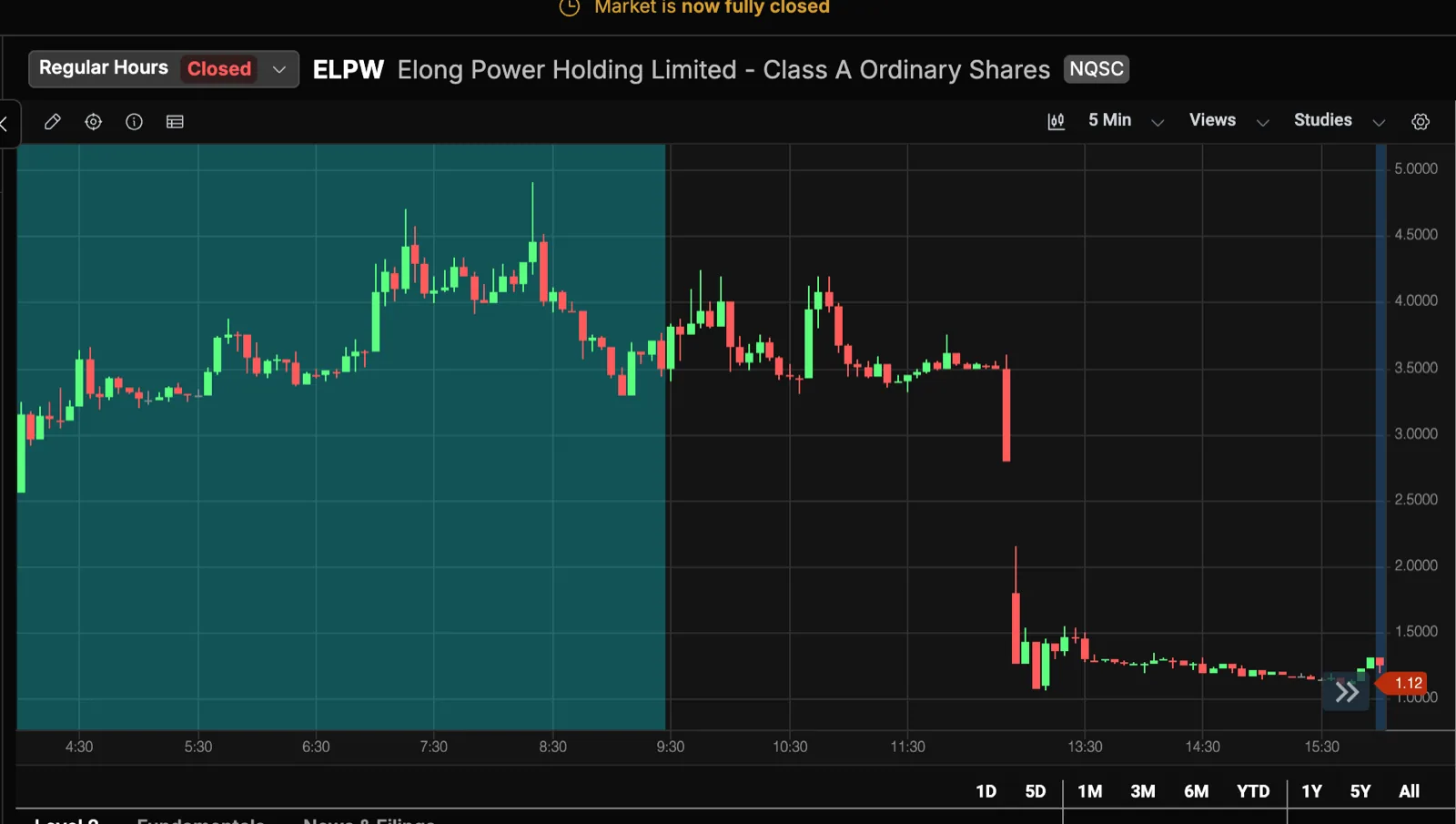

The first trade was small and quick, which is what the rules are built for; it needs a broker that takes orders at 4:10 am, and many brokers work stop orders only in regular hours, so before the open the $2.90 stop and the trail are watched by hand.
The money lost on ELPW that day was lost by holding: a share bought at the $4.24 high after the open was worth $1.80 when trading resumed. Nothing on the chart warned of the second headline; a news scan for the words such deals use would have flagged it at 12:24.
EWTX, November 5: an FDA-meeting headline that gapped on 51,633 shares
Edgewise Therapeutics (EWTX) closed at $37.53 on November 4. At 8:01:03 am on November 5 it announced a “Productive End-of-Phase 2 Meeting with FDA” and the design of its phase 3 trial: a step toward a trial, not an approval.
| Time (ET) | What EWTX did | What the rules said |
|---|---|---|
| 8:00 am | $37.25 on 1,382 shares in the bar holding the headline | |
| 8:05–8:10 | Up to $40.85, then $43.55, on 3,424 shares | Participation fails |
| 9:10 | Pre-market high $43.70; 51,633 shares in the whole pre-market | Still under 100,000 |
| 9:30 | Opened at $43.00, up 14.6%; first bar $43.24 to $40.47 on 321,243 shares | The open was the high: no spike, no setup |
| 10:35 | $37.50, under the prior close | The headline’s gain is gone |
| 10:50 | Low of the day, $36.78 | |
| Close | $38.87, up 3.57%, on 4.85 million shares |
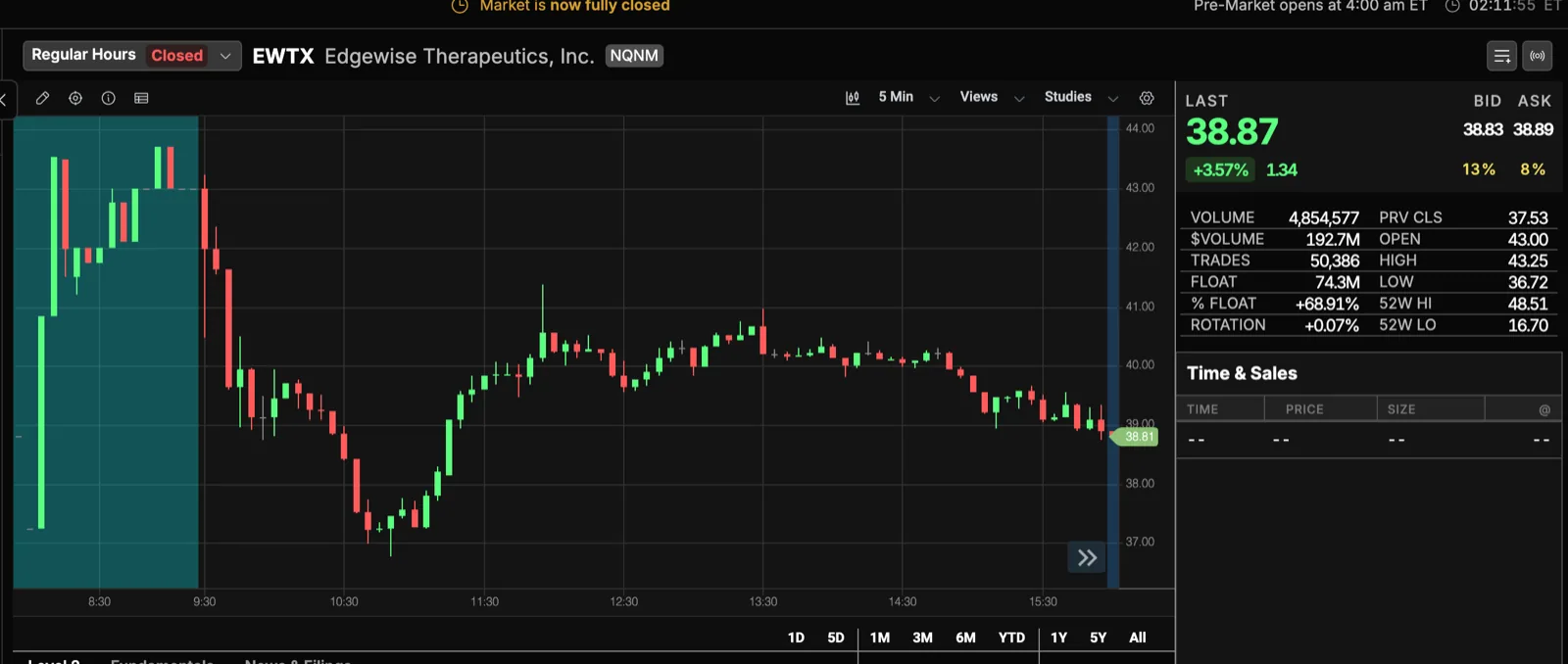
This is a common way a news trade goes wrong: the pre-market price is a handful of trades, and the open sets the real one. A buyer of the 8:10 print at $43.55 was down 7% five minutes into regular trading and 15% at the low. The rules took no trade.
ARRY, November 4: a merger whose pullbacks gave back too much
Array Technologies (ARRY) closed near $4.65 on November 3. At 7:00 am on November 4 it announced a merger with Shoals Technologies, and its third-quarter results a minute later. It was already trading before the headline: about 119,000 shares from 4:00 am, and a last trade of $4.95 at 6:50.
| Time (ET) | What ARRY did | What the rules said |
|---|---|---|
| 4:00–6:50 am | The 4:00 bar went from $4.66 to $4.98 on 37,302 shares, then $4.86 to $5.00; about 119,000 shares in all | Before the headline: not the news move |
| 6:55–7:25 | No 5-minute bars: no trades for 35 minutes around the 7:00 headline | |
| 7:30 | The first bar after the headline: $4.98–5.075 on 703,717 shares | Participation passes |
| 7:35–7:55 | Up to $5.11 at 7:40, then down to $4.90 at 7:45 and $4.825 at 7:55 | The spike ran from $4.95, the last trade before the headline, to $5.11; the pullback lost its $5.03 midpoint: skip |
| 8:25–8:35 | Pre-market high $5.30; 4.66 million shares before the open | |
| 9:30–9:40 | Opened at $5.13 and made a new high every bar, to $5.96, on 11.2 million shares | Second window: the spike runs from the $5.13 open to $5.96, midpoint $5.545 |
| 9:50 | Pulled back to $5.52 | Midpoint lost by 2.5 cents: skip |
| 10:15 | A lower high, $5.755 | |
| Close | $5.33, up 14.6%, on 51.2 million shares in regular hours |
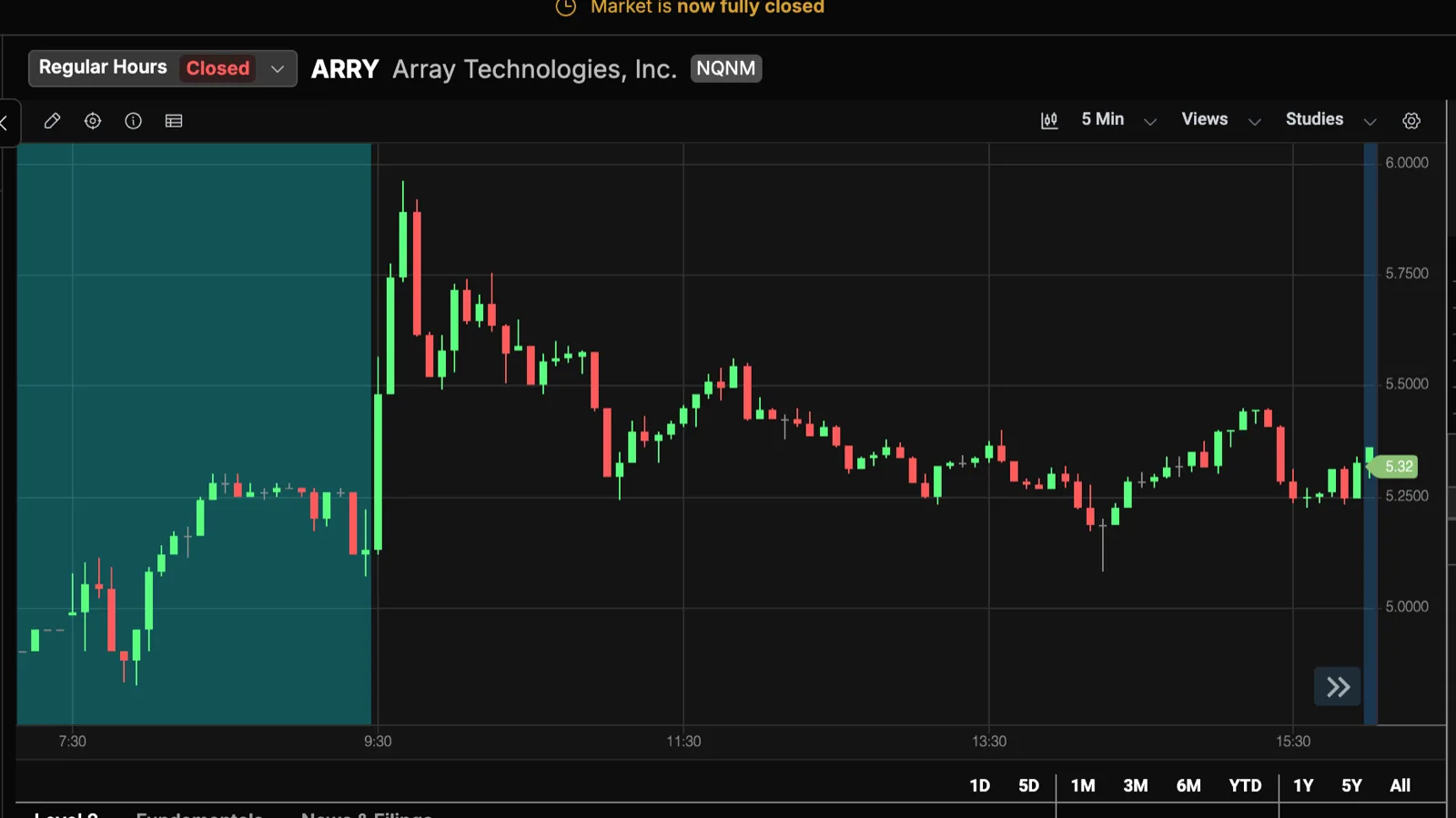
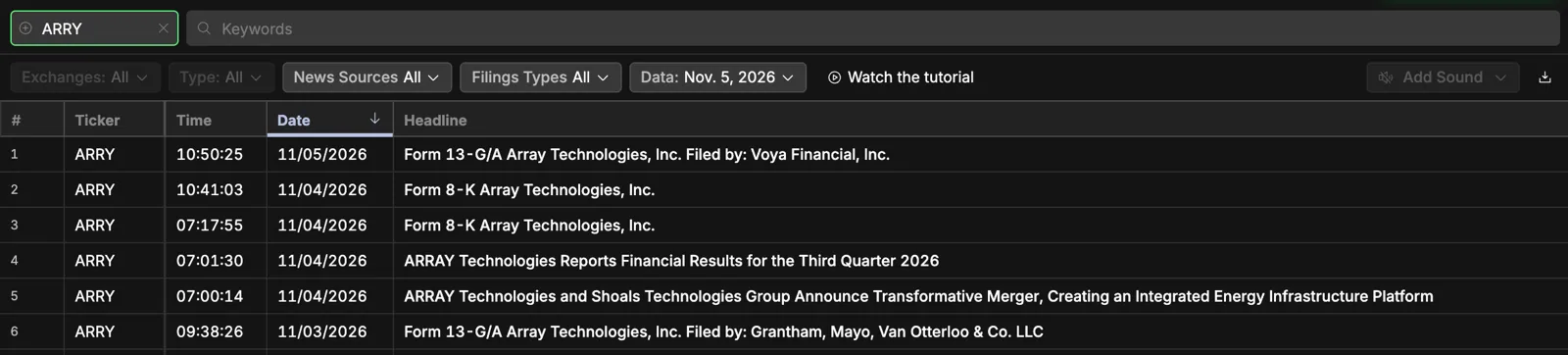
This is the cost of the pullback rule. ARRY gained 16% in its first 15 minutes of regular trading with a new high in every bar, and its one pullback, at 9:50, gave back more than half of that run, so there was nothing the rules could buy. The opening drive belonged to the gap and go setup, which buys the break of the pre-market high and accepts more false starts.
ANGI, November 4: a noon headline whose pullback lost the midpoint
Angi (ANGI) closed at $5.63 on November 3 and released third-quarter results at 4:10 pm; on November 4 it opened at $6.45 and was trading at $7.30 at noon. At 12:00:07 pm it announced “Angi Leads Home Services into AI Search with Google”, a product partnership that sells no shares.
| Time (ET) | What ANGI did | What the rules said |
|---|---|---|
| 4:10 pm, Nov 3 | Results after the close | An after-hours headline: its window closed at 5:10 pm, and only a pre-market headline gets the 9:30 window |
| 9:30 am | Opened at $6.45, up 14.6%; $7.44 by 10:05 | No window open |
| 11:55 | $7.25 to $7.32, last trade $7.30; 1.6 million shares since the open | The spike starts at $7.30 |
| 12:00 | Google headline at 12:00:07. The bar: $7.28 to $7.32 on 26,255 shares | From the company, new today, sells no shares. The window runs to 1:00 pm |
| 12:10 | Up to $7.48 on 93,481 shares, nearly three times the average 5-minute bar from 10:30 to noon | 138,264 shares since the headline: participation passes. Up 2.3% in 15 minutes |
| 12:15 | High $7.485, half a cent over the 12:10 high | The spike runs $7.30 to $7.485: midpoint $7.3925 |
| 12:20 | A lower high, $7.445, and a pullback to $7.35 | Midpoint lost by 4¼ cents: skip |
| 12:30 | $7.35 to $7.57 on 151,529 shares | |
| 12:45 | High of the day, $7.63 | |
| 1:30 pm | Back under $7.30 | Everything after the headline is gone |
| Close | $6.83, up 21.3%, on 3.27 million shares |
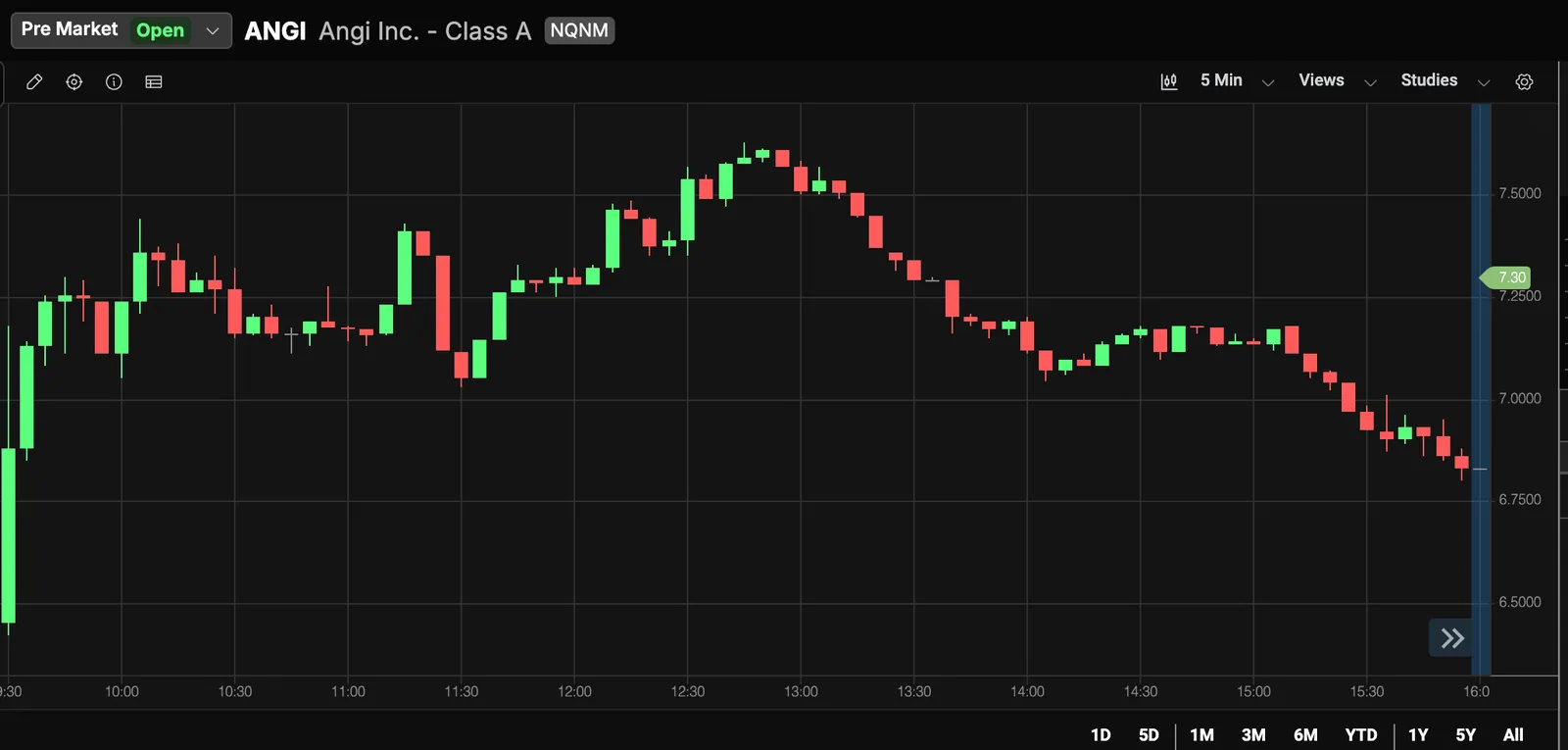
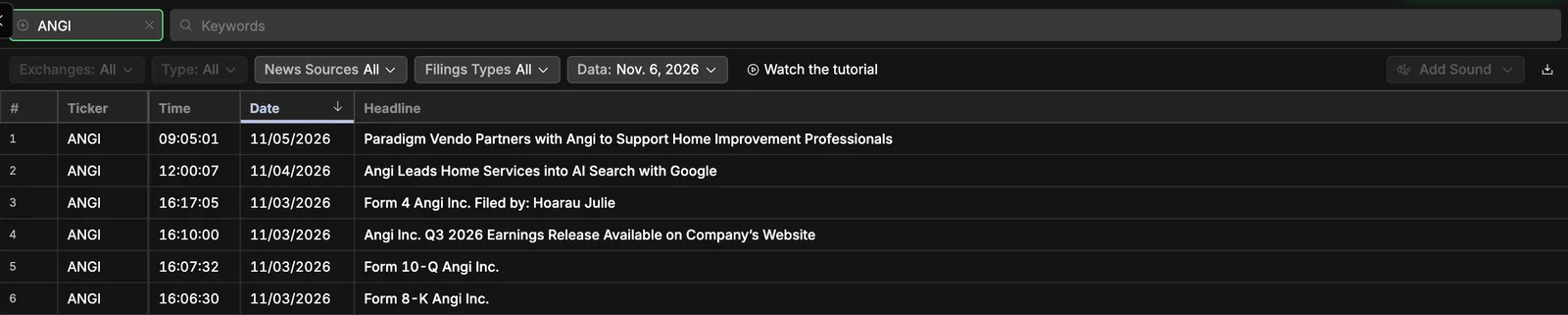
The midpoint rule cost a small winner here: bought anyway at $7.42 on the 12:30 bar, a cent over the 12:25 high, with the stop a cent under the $7.35 low, half came off at the $7.50 target in the same bar and the rest stopped at $7.48 at 12:40, about +0.9R. The spread cannot be checked after the fact, but on that 8-cent risk the limit was 0.8 cents, so a one-cent spread would have skipped the trade as well.
A noon headline meets a real market, and this one held its gain for 90 minutes before the stock closed 6.4% under the price the headline found.
What the four stocks show. The rules took one trade, ELPW’s +0.6R before the open, and stood aside on the other five setups: EWTX never had the shares, and ARRY twice, ELPW’s second window and ANGI each lost the midpoint, which cost ANGI’s +0.9R. The large losses on these charts belonged to holders: ELPW from $4.24 to $1.80 after its warrant headline, EWTX from $43.55 to $36.78 after the open.
Measured the other way: the second window from the last trade before the headline
The card measures a pre-market stock’s second-window spike from the 9:30 open. Measured instead from the last trade before the headline, ELPW’s and ARRY’s pullbacks would both have held the midpoint, and the card would have traded both.
| Stock | Spike and midpoint | Entry | Stop | 1R target | What happened |
|---|---|---|---|---|---|
| ELPW | $2.56 to $4.24, midpoint $3.40 | $4.01 on the 9:55 bar | $3.79 | $4.23 | High of $4.20 in that bar, then the 10:00 bar fell to $3.47: −1R |
| ARRY | $4.95 to $5.96, midpoint $5.455 | $5.625 on the 10:00 bar | $5.48 | $5.77 | High of $5.755 at 10:15, a cent and a half short; stopped at 10:35: −1R |
Two trades are not a test, but on these two the open was the better place to measure from.
How does the trade change before the open, during the day, after hours, on bad news or in a cheap stock?
Pre-market headlines. Many releases in the feed on November 4 and 5 came between 7:00 and 8:01 am ET. The pre-market copy and the News Scanner find these. Volume is thin and spreads are wide, so the participation test does most of the work: EWTX failed it, ARRY passed. Widen the News Count window to 2–4 hours so the stock is still listed at 9:30. If it runs from the bell without a pullback, that is a gap and go, with its own rules.
Intraday headlines. The case Moving on News NOW is built for. Volume is already there, so a headline at 11:00 or 2:00 meets a real market and the rules apply as written; ANGI’s noon headline above passed participation in ten minutes and failed only the midpoint. A news stock that later rests under its high becomes a high of day setup.
After-hours headlines. Results often come just after the 4:00 pm close: Edgewise filed its quarterly report at 4:02 pm on November 4. After-hours trading is thin and broker sessions vary. The 60-minute window still applies, and if your broker is closed for it, there is no trade.
Bad news. The mirror exists: a spike down, a bounce that stays below the midpoint, a break of the previous bar’s low. Scanz has no borrow data, so confirm your broker can lend the shares before the headline, not during it.
Small, cheap stocks. ELPW, the cheapest stock on this page at $2.51 the evening before, shows what changes. Its first stop was 29 cents, 9% of the $3.19 entry, so $100 of risk bought 344 shares, and the spread rule allowed a spread of at most 2.9 cents. In regular hours a stock from $0.75 to $3 has a Limit Up-Limit Down band of 20% instead of the 10% above $3 (LULD plan), so it can move further before a pause.
The companies also sell shares into the move: ELPW eight hours after its good news, DTIL ten minutes after. On a cheap stock the offerings scan runs from the first trade, and a copy of Moving on News NOW with a Float or price filter keeps these stocks in a list of their own (filter reference).
Halts. Under Limit Up-Limit Down, a stock that leaves its price band and does not return “within 15 seconds” pauses for five minutes (SEC); a halt for pending news has no fixed length. Scanz carries no halt data. ELPW’s 25 minutes with no bars from 12:25 to 12:45 is what a stop in trading can look like on a 5-minute chart, though the chart does not say why; check the listing exchange’s halt page when the tape goes quiet. A stop order does not protect you through a halt.
Why do news trades fail, and what can’t the scan see?
Many do, and the failures look alike:
- The pre-market price was not a price. EWTX was up 16% by 8:10 am on 4,806 shares.
- The headline was a step. A good meeting, a plan to file, a letter of intent.
- The next headline sold shares. ELPW’s warrant deal and DTIL’s offering came within hours of good news.
- The story was old. Reprints get traded, then reverse. Search by ticker shows whether it ran last month.
- The cause was not in the feed. Analyst calls and stories from outside the wires move stocks with no headline; KXIN rose about 10% on November 5 with nothing in the feed since September 16.
The scan cannot see whether the headline caused the move, whether the number in the title is firm, whether a halt is coming, or the spread when you click. It finds the stock and puts the headline beside it; the reading and the exit are yours.
The rules here fix the size of each loss before the trade; they do not promise a winner.
The checklist before a news trade
Before the trade
- Have you read the headline itself, not just seen the ticker on a scan?
- Is it new today, and an outcome rather than a step?
- Is it from the company or the SEC, not a promotion?
- Does it say nothing about an offering, warrants or an at-the-market program?
- Have at least 100,000 shares traded since the headline?
- Has the spike pulled back and held above its midpoint?
- Is it within 60 minutes of the headline, or 9:30–10:00 for a pre-market one?
- Is the spread under a tenth of the distance to your stop?
- Do you know your stop, your 1R and your share count?
- Is a news scan with a sound watching for the next headline?
Questions traders ask
How do you trade breaking news in stocks?
Find the stock moving on a fresh headline, read it, and wait for the first spike to pull back. If the pullback holds above the spike's midpoint, buy the first 5-minute bar that trades above the previous bar's high, stop a cent under the pullback, and take half off at 1R.
Does the Moving on News NOW scan work before the open?
Not as Discover stores it. Its relative-volume rule counts regular-hours trading only, so it lists stocks from 9:30 ET; on November 6, 2026 it listed none in 12 reads between 8:11 and 8:19 am. A copy with that rule's Session set to Pre-Market listed four stocks in 66 reads between 8:29 and 9:15 the same morning. Read each headline: one of the four had no new headline that day, and another was held on the list by a law-firm notice.
Is news trading profitable?
Not reliably, and this page claims no win rate; these rules have not been tested on a large sample. On the four stocks and five headlines on this page, November 4 and 5, 2026, they took one trade, +0.6R, and passed on five setups, one of which would have made +0.9R. Most persistent day traders lose money. What the rules control is the size of each loss.
Is it legal to trade on news?
Trading on news that has been made public, on a wire or in an SEC filing, is legal. Trading on material information before it is public, from someone with a duty to keep it confidential, is insider trading.
How fast do stocks react to news?
Within minutes. In a study of Bloomberg news, stories on the terminal's front page drew larger price moves in their first 10 minutes than equally important stories placed elsewhere, and were fully priced within about an hour. EWTX was up about 9% by 8:05 am and 16% by 8:10 after its 8:01 headline; ELPW's fall to $2.80 came inside the bar that held its 12:24 pm headline.
Can a retail trader compete with algorithms on headlines?
Not on the first print, and there is no need to. The pullback entry lets the machines and first buyers finish, then asks whether anyone is still buying.
What news moves stocks the most?
Decisions and signed deals: a regulator's approval or rejection, a merger with a price, results far from expectations. Offerings and warrant deals move stocks down.
How do you tell a real catalyst from a promotion or a recycled headline?
A real catalyst comes from the company on a press-release wire or in an SEC filing and names its numbers and counterparties. Search the ticker in the News Scanner: if the same story ran last week, today's move is on stale news.
Should you buy the first spike or wait for the pullback?
These rules wait: the spike gives you no known price and no level for a stop, and the pullback gives you both. The cost is the stocks whose pullbacks give back too much, like ARRY on November 4, 2026, and the occasional winner that rule skips, like ANGI's +0.9R at noon the same day.
Why is a stock moving with no news in the feed?
The cause may be outside it: an analyst rating change, a story from an outlet that is not a press-release wire, or a sector move. Scanz carries SEC filings and five press-release wires, not analyst research.