What is stock dilution, and why does an offering drop a stock?
Dilution is a company issuing new shares: each existing share becomes a smaller slice of the same company. For a day trader the slice matters less than the supply. A company that sells 10 million new shares has 10 million shares to place with buyers, usually at a discount to the last trade, and the people who bought them at that price can sell them the next morning.
That is why a small-cap runner so often dies on a filing. A stock goes up 200% on news; the company, which may have months of cash left, now has the best price it has seen all year; it sells shares into the move. The deal is priced below the market so the buyers take it, and the stock tends to trade toward that price, because that is where new supply is now available.
Not every filing is a sale. The useful line is between permission and a priced deal:
- Permission: a registration statement on file (S-1, S-3) that lets the company sell later. Nothing is sold yet. Traders treat it as a reason not to hold a runner overnight.
- A priced deal: a number of shares at a price, announced in a press release, an 8-K or a 424(b) prospectus supplement. This is the event the main play below is built on.
What each filing means for a small-cap trader
Each definition below links to the SEC’s own page or form.
| Filing | What it is | What it means on a small-cap chart |
|---|---|---|
| Form S-1 | The general registration statement under the Securities Act, used when “no other form is authorized” (Form S-1). Small and newer companies use it to register an offering. | A pending S-1 (and its S-1/A amendments) is a deal being prepared. When the SEC declares it effective, the company can price within hours: OPTT’s went effective on November 12, 2026 and priced the same day. |
| Form S-3 | The short-form registration for companies that are current in their reports; used for a shelf, securities registered now and sold “on an immediate, continuous or delayed basis” for up to three years (Form S-3, Rule 415). | A shelf is permission, not a sale. If the company’s public float is under $75 million it can sell no more than one-third of that float in any 12 months under the shelf (General Instruction I.B.6, the “baby shelf” limit). The sale itself comes later, in a 424(b) prospectus supplement. |
| ATM program | An “at the market” offering: shares sold “into an existing trading market … at other than a fixed price” through an agent (Rule 415(a)(4)), off an effective shelf. | No announcement per sale. The agent sells into strength, so a stock with an open ATM tends to stall on rallies. The program’s size is in its prospectus supplement; what was actually sold shows up in the next quarterly report. |
| Form S-4 | Registration for securities issued in a merger or “an exchange offer” (Form S-4). | New shares paid to another company’s holders. In small caps it often means a reverse merger: a new share count and a new float once it closes. |
| Form D | A notice of an exempt offering (a private placement), filed “within 15 days after the first sale” (Form D). | The deal has already happened. The buyers hold restricted shares, which they usually sell only after a resale registration (an S-1 or S-3 naming them) goes effective. Watch for that resale filing next. |
| Form 144 | A notice of proposed sale by an affiliate (an officer, director or large holder), required when the sale is more than 5,000 shares or $50,000 in three months (Rule 144). | Not new shares: an insider selling existing ones. It is a notice of intent; the sale itself is reported on Form 4. In a thin small cap it is supply; in a large cap it is usually routine. |
| Warrants | A right to buy shares at a set price for a set time. OPTT’s November deal attached one warrant per share at a $0.50 exercise price, exercisable at once, for five years (OPTT 424B4). | More shares later, whenever the stock trades above the exercise price, so the exercise price works as a ceiling of fresh supply. |
When the filings arrive
EDGAR accepts filings from 6:00 am to 10:00 pm ET on business days; most filings sent after 5:30 pm ET are dated the next business day, while Forms 3, 4, 5 and 144 keep the same day’s date until 10:00 pm (SEC: filing status and hours). So a deal can land in the pre-market, in the middle of the session, or after the close, and the after-hours ones are what the next morning’s gap is made of. Every example on this page has one: SLS’s offering was filed at 4:14 pm ET, AZI’s at 5:36 pm, THRY’s shelf at 7:30 am.
The play, drawn
How do you see dilution filings as they hit?
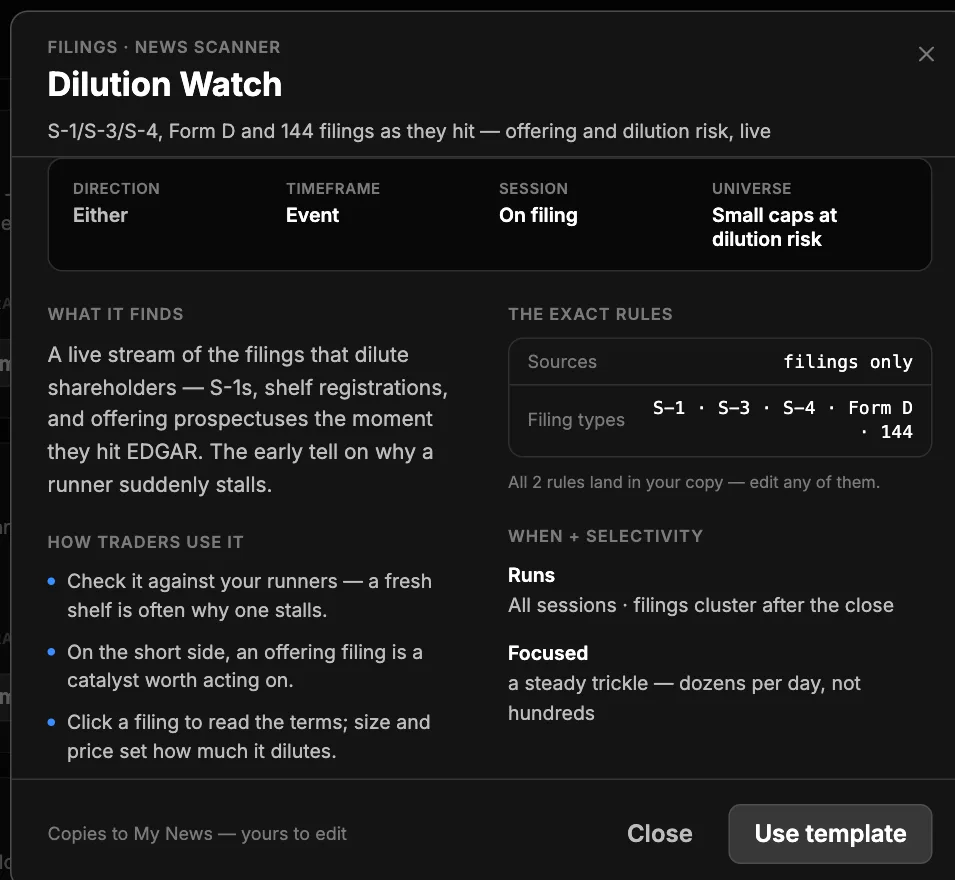
Dilution Watch is a News Scanner template in Scanz’s Discover. It is a feed, not a price scan: no price, volume or session rules, just the filings, newest first, the moment they reach the feed.
The scan · News Scanner · All sessions, as filings arrive
Dilution Watch
| Rule | Setting | Why it's there |
|---|---|---|
| Sources | Filings only | The primary documents, not articles about them. The feed shows the filing as EDGAR publishes it. |
| Filings Types | Form S-1 · Form S-3 · Form S-4 · Form D · Form 144 (5 Active) | The registrations that let a company sell new shares, the merger form that issues them, the private-placement notice, and the insider's notice to sell. |
| Stock filters | None (Active filters 0) | Every company that files shows up. Add a price or float filter to your copy to keep it to small caps (settings below). |
The Discover card reads: 'Runs: All sessions · filings cluster after the close' and 'a steady trickle — dozens per day, not hundreds'. It copies to My News, where you can add a sound. The Filings Types list has no type of its own for 424B prospectus supplements, the document that prices most shelf deals, or for the F-1 and F-3 forms foreign companies register on.
7 days of Pro free, card required: this feed with a sound, and the offering-headlines scan below. After day 7 it renews on the plan chosen at sign-up, Starter at $89/month or Pro at $199/month, unless you cancel in the app. Starter keeps one news scan; headline keywords are Pro.
What the feed shows, and what it does not
It shows the ticker, the time the filing reached the feed, and a headline with the form and the company: “Form S-3 Thryv Holdings, Inc.”, “Form 144 TWIN DISC INC Filed by: …”. Click a row to read the filing.
It does not show whether a deal has priced, at what price, or how many shares. A shelf and a $150 million priced offering look the same in the headline if both are S-3s, and the price usually arrives in a document the template does not carry. Read the filing, or the press release on the newswires, for the terms.
It is fast. On November 20, 2026 we checked five rows against EDGAR’s acceptance times: each reached the feed 20 to 62 seconds after EDGAR accepted it (THRY’s S-3, accepted 7:30:42 am ET, showed at 7:31:16).
When a row hits: what to open, what to decide
A row is a prompt to read, not a signal to trade. What traders check, by form, on a stock they hold or are watching:
| Row | Open | Look for | What it changes today |
|---|---|---|---|
| S-1 or S-1/A | The cover page and “The Offering” section | Shares or dollars offered, warrants, the placement agent, whether it is a resale (selling holders named) | A pending S-1 on a runner means a deal can price the day the SEC declares it effective. No overnight long |
| S-3 | The cover page | The dollar cap, whether it is effective yet, any mention of an at-the-market program | Permission to sell. If the stock is running, the 424B that prices a takedown can follow within hours |
| S-4 | The cover and the exchange ratio | How many new shares the merger issues against today’s count | A new float once it closes; the float in Scanz will lag it |
| Form D | Item 13 (amount sold) and Item 14 (investors) | Whether the raise is done and how large | The shares are restricted; watch for the resale S-1 or S-3 that frees them |
| Form 144 | The share count and the approximate sale date | Size against the day’s volume and the float | Existing shares for sale, not new ones. Matters in a thin small cap, rarely in a large one |
The second scan: offering headlines
Most small-cap deals are announced by press release before or alongside the filing, and the release is where the price is. A keyword news scan catches those. This one is not a template; you build it in the News Scanner, and it is the same scan the news trading guide uses for exits.
The scan · News Scanner
Offering headlines (your own news scan)
| Rule | Setting | Why it's there |
|---|---|---|
| Keywords | offering · warrant · registered direct · private placement · at-the-market | The words in the releases that announce and price new shares. A keyword matches anywhere in a headline, ignores case, and any one is enough. |
| Excluded | -warranty · -class action | "warrant" also matches "warranty", and class-action notices often mention an offering. |
| News Sources / Filings Types | All | The release usually comes on a wire first and the filing a minute or more later. |
| Sound | Sound 1 to Sound 10 | A pricing headline on a stock you trade has to reach you while you watch its chart. |
Keyword search is a Pro feature. Filing headlines carry the form and company name, not the deal, so these keywords match press releases, not filings.
Settings to change, and when
| Change | When | What it costs |
|---|---|---|
| Add Last Price ≤ 20 or Float ≤ 20,000,000 | You only trade small caps. On November 20 the large-cap Form 144s (ADP, HSY, ABNB, PGR) were most of the feed | Drops the rare large company whose filing moves a small cap you trade, such as a merger partner |
| Uncheck Form 144 | You only want new-share filings | Loses insider selling, which is real supply in a thin stock |
| Check Form 8-K and Form 6-K | You want the current report that often confirms a priced deal (6-K for foreign companies) | Many more rows: every 8-K, not only financings |
| Check Form FWP | You follow deals marketed overnight | Free-writing prospectuses also cover debt and large-cap deals |
| Add a Sound | Always, for a stock you hold or watch | None |
A data scan cannot see filings, but it can see that a stock has fresh headlines: the News Count filter and column count headlines over a window from 1 minute to 4 hours. A runner whose News Count jumps after the close is worth opening in the feed.
How do traders trade around an offering?
Read the traders who publish how they handle dilution and three plays come up, in this order of how often:
- Don’t hold a runner that can sell shares. The most common rule, and a risk rule more than a trade. Guy Gentile calls dilution “mostly a reason to be flat by the close” on a name with a shelf and no cash (guide); Tim Sykes’s first tip on offerings is to avoid them (post).
- Short the pop after the deal prices. Once the price is public, the stock has a level where new supply sits. Traders short the failed bounce and target that price; CenterPoint, a short-locate broker, writes that trading secondaries “can be fruitful on the short side” (CenterPoint).
- Buy the offering bottom. The new buyers defend their price, so the offering price can act as support. SMB Capital describes it on a liquid NYSE name: the support is “the place where they did the deal” (SMB). In small caps it fails often, because the new shares and warrants are what is being sold.
The first is a rule every trade on this page obeys; it does not make money on its own. The second is the trade small-cap traders take when an offering hits, so it is the main play below. The third is a variation with its own card. One caution on the short: Thomas Bulkowski’s test of 267 offerings from 2004 to 2009, mostly larger companies, found that simply shorting them lost money on average (Bulkowski). That is why the card waits for a pop to fail instead of shorting the open.
What are the rules for the offering fade?
The offering fade on one card
- In play
- The deal has priced: a press release, 8-K or 424B prospectus supplement gives the offering price, on a stock that ran into it
- Session
- The first regular session after the price is public
- Time window
- Entries 9:35–11:30 am ET; flat by 3:55 pm ET
- Level
- The pop's high: the highest price of the first push up after the open
- Trigger
- A 5-minute bar closes under VWAP after the pop
- Entry
- Short at the close of the trigger bar
- Stop
- Above the pop's high. Shares = the dollars you will risk ÷ the distance from the entry to the stop
- Target
- The offering price (for convertible notes, the fixed conversion price). Cover there, or by 3:55 pm ET
- Attempts
- One a stock
- Skip it when
- It opens at or under the offering price; the offering price is less than 1R below the entry; you cannot borrow it; the stop is more than one pause band away (10% over $3, 20% from $0.75 to $3); the deal priced at or above the market
Why each rule is there
- Priced, not filed. Before the price, the stock has no level to trade toward, and shorts who sell on “offering coming” get squeezed: SLS rallied from $17.22 to $21.40 on the day between its preliminary prospectus and its price (below).
- The first session. The discount is new information once. By the second day the market has had a full session to trade toward it.
- A pop first. The open after a pricing is crowded with dip buyers and shorts covering. Shorting it blind is the trade Bulkowski’s numbers say loses; a pop that fails shows the buyers ran out.
- VWAP. It is the average price paid today. A close back under it after the pop means the average buyer of the morning is losing, and they become sellers on any bounce (VWAP guide).
- The offering price as target. It is where new shares changed hands, and the new holders defend it at first. Covering there takes the move the discount explains, and leaves the offering-bottom bounce to someone else.
- Opens at or under the price. Then the discount is already in the price and there is nothing left to target. OPTT on November 13 is the example.
- Borrow. A stock that just priced an offering is often hard to borrow, and Scanz has no borrow or locate data; check with your broker before the open.
- The pause band. Under the Limit Up-Limit Down plan a stock is paused for five minutes when it sits at its band for 15 seconds; a stop wider than one band can be jumped by the reopen (LULD plan).
- Priced at or above the market. A premium deal, often to a strategic buyer, removes the discount the trade is built on.
What did offerings look like in November 2026?
The feed, live, on November 20
This is Dilution Watch at 12:03 pm ET on Friday, November 20, 2026, copied from Discover with no changes.
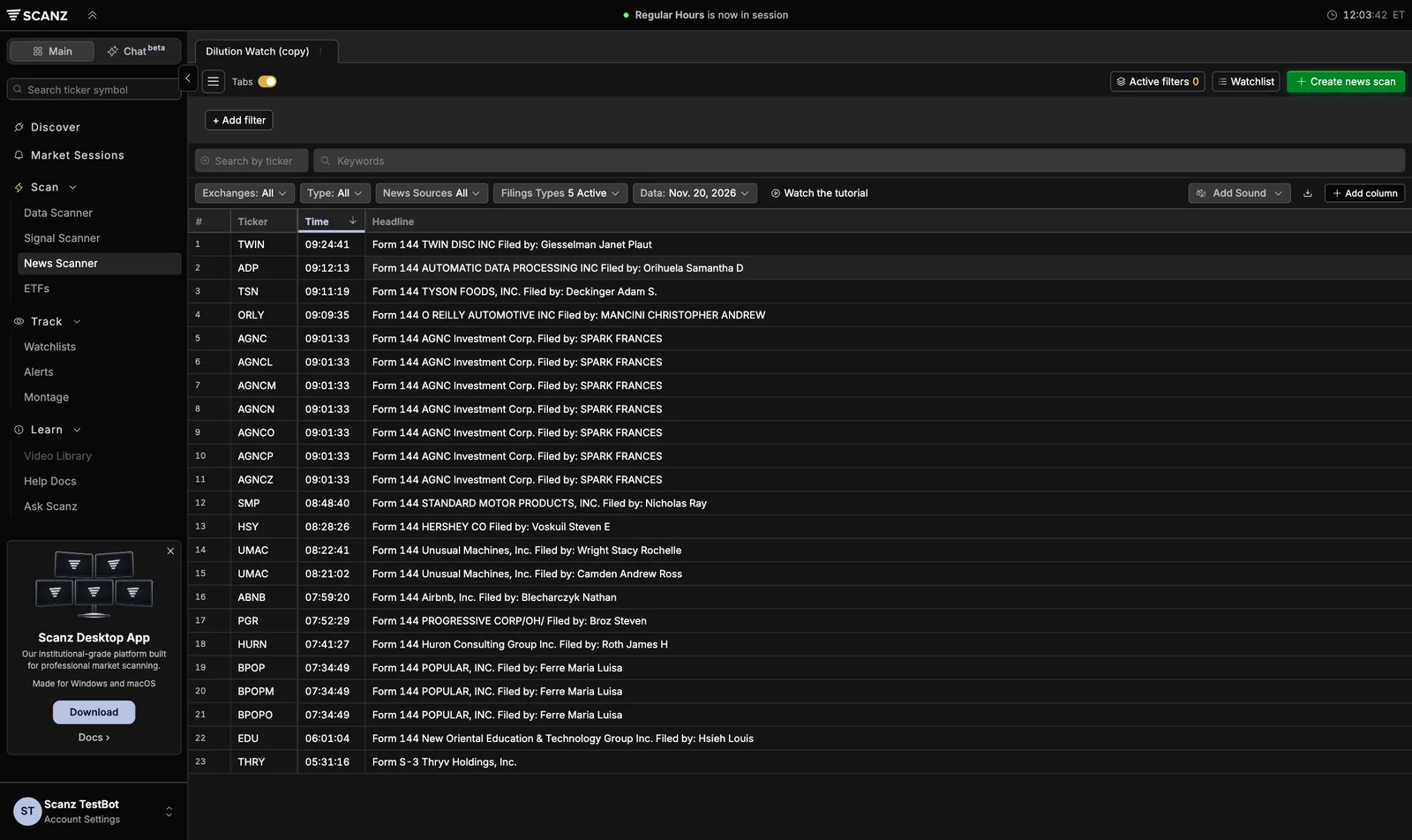
| Time (ET) | Ticker | Filing | What it was |
|---|---|---|---|
| 7:31 am | THRY | Form S-3 | A $50 million universal shelf (debt, common, preferred, warrants, an ATM allowed), not yet effective. THRY had closed at $0.69 on November 19, down from $1.28 on November 9 (S-3) |
| 8:01 am – 11:24 am | EDU, BPOP (3 tickers), HURN, PGR, ABNB, UMAC (2), HSY, SMP, AGNC (7 tickers), ORLY, TSN, ADP, TWIN | Form 144 | 14 notices of proposed insider sales. A company with preferred shares fills one row per ticker, which is why one AGNC filing is seven rows |
What it says about the feed:
- Most of a normal day is Form 144s. Fourteen of the 15 filings were insiders’ notices, and most from large companies. That is what the settings table’s price or float filter is for.
- A shelf is not a sale. THRY’s S-3 is permission to sell up to $50 million once the SEC declares it effective; nothing was sold on November 20. By 12:40 pm THRY traded at $0.75, up from $0.69. A trader long THRY now knows the company can sell into any rally once the shelf is effective.
- A 144 on a small cap reads differently. UMAC, at about $8.80 and down from $13.48 on November 9, had two insiders file notices within two minutes (10:21 and 10:22 am). It is supply of existing shares, not dilution, and it is not a trade signal by itself.
- No S-1, S-4 or Form D by noon. Deals cluster after the close; the capture ended before it.
An ATM, live: MEDS on November 20
DataMeds AI (MEDS) opened an at-the-market program at 6:22 am ET on November 16 for up to $10.0 million through Dawson James, then cut it to up to $7.05 million at 5:24 pm on November 17 (prospectus supplement). The supplement counts 5,724,857 shares outstanding on November 16. At $1.04, $7.05 million is about 6.8 million shares: more than every share the company had.
On November 20 MEDS was one of the day’s movers. The Montage at 12:10 pm:
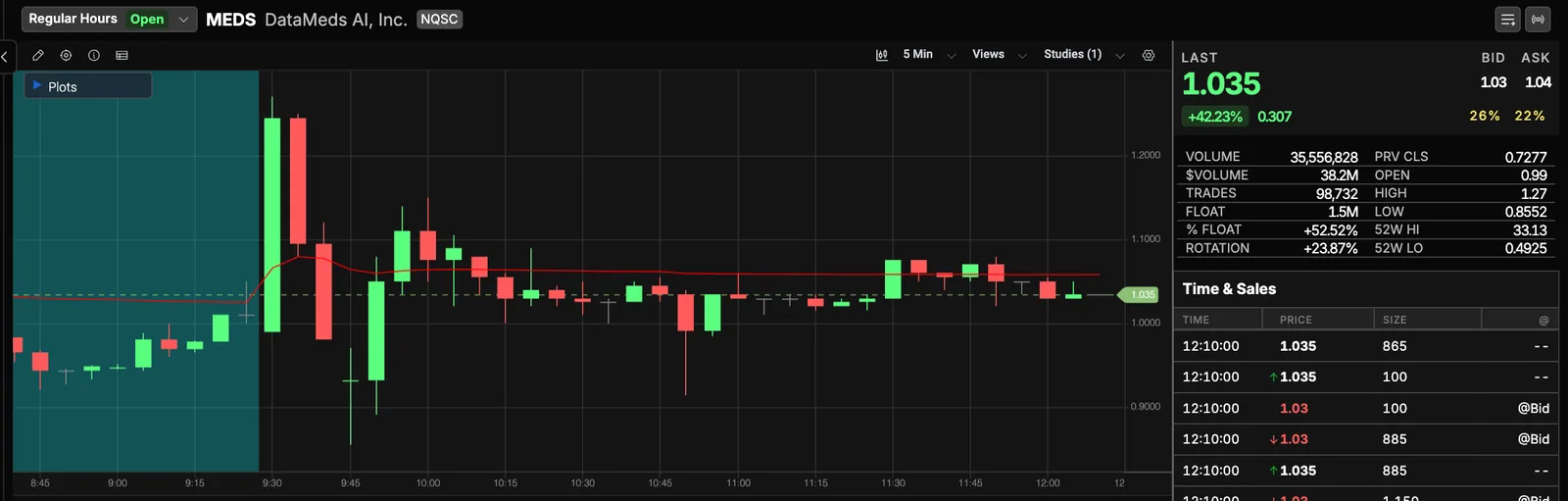
- The shape an ATM leaves. A spike to $1.27 in the first five minutes, a flush to $0.86, and then from 10:45 a stock that rallies to VWAP (about $1.07) and does not hold above it. Whether the agent sold that morning is not public until the company reports; the chart is consistent with a seller above the market, which is what an open ATM is.
- The float is stale. Scanz showed a 1.5 million share float that is 52.52% of shares outstanding, which puts its share count near 2.8 million; the November 16 prospectus counted 5,724,857. The float in Scanz can lag new shares by weeks, so after an offering or an ATM it can be too small, and float rotation too high. Check the latest 424B or 10-Q cover on EDGAR when the float matters.
- No offering-fade trade. An ATM has no single price to target, so the card does not apply. What applies is rule 1: a long in MEDS above VWAP has a seller overhead.
The main play, traded: SLS, November 17–20
SELLAS Life Sciences (SLS) is the cleanest sequence of the month: a shelf on file since March, a big headline, an offering filed the same afternoon, and a price the next night.
| When (ET) | What happened | Source |
|---|---|---|
| March 20, 2026 | S-3 shelf filed, effective on filing (an automatic shelf) | 8-K, Nov 20 |
| Nov 16, close | $7.47 | Nasdaq close in the prospectus |
| Nov 17, 7:14 am | 8-K: positive Phase 3 results for its AML vaccine | 8-K |
| Nov 17, session | Opened near $24, high $24.89, low $16.70, closed $19.15 on 120 million shares | Public price data |
| Nov 17, 4:14 pm | Preliminary 424B5: a $150 million offering, no price | 424B5 |
| Nov 18, session | Opened $19.51, fell to $17.22, rallied to $21.40 at 11:30, closed $17.95. No price yet: the card had no trade | Public price data |
| Nov 18 | Priced: 11,538,462 shares at $13.00, 27.6% under the $17.95 close; 5.7% of the 203.5 million shares outstanding (6.5% with the underwriters’ option). By 4:00 am on Nov 19 the stock traded at $14.76 | 424B5 final |
| Nov 19, 9:30–9:40 | Opened $15.39, popped to $16.54 (the pop’s high) | 5-minute bars |
| Nov 19, 9:35 bar | Closed $15.635, under VWAP ($15.93): the trigger. Short $15.635, stop $16.55, risk $0.915 (5.9%, inside the 10% band). Target $13.00, 2.9R away | Card |
| Nov 19, rest of day | Low $14.23 at 2:55 pm; covered at 3:55 pm at about $14.67: +1.05R. The $13.00 target was not reached | 5-minute bars |
| Nov 19, 4:07 pm | Final 424B5 filed, a day after the price was public | EDGAR |
| Nov 20, to 12:40 pm | Low $13.385, at $13.56: still above the $13.00 deal price | Public price data |
VWAP here is computed from public 5-minute bars, so treat it as within a few cents. What SLS shows: the day between the preliminary filing and the price was the dangerous one for shorts (a $4.18 rally off the low); the day after the price did what the card expects but did not reach the target; and the offering price, two days later, had not yet been tested.
A failure: AZI, November 18
Autozi (AZI) ran from $0.506 to $0.98 on November 17 on 38.9 million shares. At 5:36 pm ET it filed a registered direct of $12.75 million in senior secured convertible notes, convertible at a fixed $0.5232, or at 93% of a recent low VWAP with a $0.10464 floor, with up to $17.25 million more (424B5). At the fixed price, $12.75 million is about 24 million shares, 43% of the 56.3 million Class A shares outstanding.
| Time (ET), Nov 18 | What AZI did | What the card said |
|---|---|---|
| After hours Nov 17 – pre-market | Traded up to $1.37, then down to $0.76 by 8:00 am | Pre-market: no entries |
| 9:30–9:50 | Opened $0.86, dipped to $0.77, popped to $0.95 | Pop’s high: $0.95 |
| 10:00 bar | Closed $0.839, under VWAP ($0.879) | Short $0.839, stop $0.96, risk $0.121 (14%, inside the 20% band). Target $0.5232, 2.6R away |
| 10:20 bar | Traded to $1.019 | Stopped, −1R |
| Close | $1.04 |
The stock fell the next day: it opened at $0.714 on November 19, closed at $0.55, and traded at $0.46 at midday on November 20, near the conversion price. The card’s one attempt was on November 18 and lost. Convertible notes add a wrinkle a share offering does not: the alternate conversion price falls as the stock falls, so the “offering price” is a fixed number on paper and a moving one in practice. AZI registered its shelf on Form F-3 and priced in a 424B5, neither a type Dilution Watch carries; a copy with Form 6-K checked would have listed the 6-K it filed at 9:47 pm, and the offering-headlines scan would catch any press release.
Skip: OPTT, November 13
Ocean Power Technologies (OPTT) had an S-1 pending, amended on October 29 and November 5. It ran from $0.43 to an intraday $0.89 on November 12, the day the SEC declared the S-1 effective, and priced that day: 6,000,000 shares with 6,000,000 warrants at a combined $0.50, warrants exercisable at $0.50 for five years, $3.0 million gross, best efforts through a placement agent (424B4). On November 13 it traded at about $0.66 at 7:00 am and $0.42 by 7:45 am, and opened at $0.354, already 29% under the $0.50 deal. The card skips it: the discount was gone before the bell. It closed at $0.32. For the offering-bottom buyer, OPTT is the warning: a best-efforts deal with a warrant for every share left no buyer defending $0.50.
The ledger
| Stock | Deal | Card | Result |
|---|---|---|---|
| SLS | $150M underwritten at $13.00, 27.6% under the close | Traded Nov 19 | +1.05R, out at 3:55 pm; target not reached |
| AZI | $12.75M convertible notes, fixed conversion $0.5232 | Traded Nov 18 | −1R; the stock fell 47% the next day |
| OPTT | $3.0M shares and warrants at $0.50 | Skipped: opened under the price | No trade |
| MEDS | ATM up to $7.05M | Not a priced deal | No trade |
| THRY | $50M shelf, not effective | Not a priced deal | No trade |
Two trades, +0.05R together. That is two trades, not a test: it says what the rules did on these sessions, not what they do on average.
Variations
The offering bottom (long)
Some traders buy the offering price instead of shorting toward it. The logic: the new holders paid that price and defend it; once the stock holds it and the sellers are done, it bounces. The rules differ from the fade:
The offering bottom on one card
- In play
- An underwritten deal at a fixed price, with no warrants, on a stock trading within 5% of that price
- Setup
- The stock trades down to the offering price and no 5-minute bar closes more than 1% under it
- Trigger
- A 5-minute bar closes back above VWAP
- Entry
- At the close of the trigger bar
- Stop
- Under the offering price, by 1% or the day's low, whichever is lower
- Exits
- Half at 1R; the rest by 3:55 pm ET
- Skip it when
- The deal was best efforts or carries warrants; it has already closed under the price; an ATM is open on the same shelf
SLS on November 20 is the setup forming: an underwritten deal at $13.00 with no warrants, the stock at $13.56 at 12:40 pm, low $13.385. It had not closed back above VWAP, so there was no trigger. OPTT is why the card skips best-efforts deals with warrants.
The overnight check before holding a long
The standing rule, made into four checks a trader can run in five minutes on any small cap they want to hold past 4:00 pm. Each is a line in a filing on EDGAR, and the first is a search in Dilution Watch (set Data to an earlier date).
- Can it sell shares tonight? An S-1 still pending, an S-3 shelf that is effective, or an ATM prospectus supplement. Any one is permission.
- Does it need to? Cash on the latest 10-Q balance sheet against cash used in operations. If cash covers less than two quarters, it will raise; the only question is which rally.
- Has it been issuing? The share count on the 10-Q cover against the one before it, or against the latest 424B. A count that grows quarter after quarter is a company that funds itself with stock.
- Is anything already sold and waiting? A Form D or registered direct whose buyers now have a resale registration, and warrants with an exercise price under today’s price.
MEDS on November 20 fails three of the four. It had an ATM open since November 16 (1). Its 10-Q showed $476,598 of cash on September 30 against $9.2 million used in operations in the first nine months, about $3 million a quarter, with the auditors’ going-concern doubt (2) (10-Q). Its share count went from 4,730,148 on September 30 to 5,724,857 on November 16, up 21% in seven weeks (3). Only (4) passes: its 9,442,355 warrant shares carry a weighted average exercise price of $7.31, far above a $1.04 stock. A long in MEDS that day was a long against a company with the reason and the means to sell into it.
During the day, a stock with an open ATM is a stock with a seller above the market: MEDS’s late morning under VWAP on November 20 is what that can look like.
Registered directs and convertibles
A registered direct is a deal sold to a few investors off a shelf, often overnight, often with warrants. It is priced like an offering, so the fade card applies, using the per-share price. A convertible note has a conversion price instead; the card uses the fixed price, and AZI shows how the alternate price can pull the stock under it.
After a reverse split
A company that reverse-splits to keep its listing often has a shelf ready, and the split leaves a small share count and a high price to sell at. Ross Cameron checks for an “S-3 or F-3 shelf registration” before trading one (Warrior Trading). The float in Scanz is the most likely to be stale in exactly these names.
When does the offering fade fail?
The stock squeezes. A stock that just priced a deal is a crowded short, and borrow is scarce. A short squeeze through the pop’s high is how the card loses; AZI went from $0.839 to $1.019 in 20 minutes.
The deal is good news. Money that removes a going-concern risk, or a deal priced at a premium to a strategic buyer, can lift a stock. The skip rule covers the premium; the rest is reading the release.
The price comes later than you think. Between a preliminary filing and the price, the stock has no level, and SLS rallied 24% off its low on that day.
The feed does not price the deal. Dilution Watch shows S-1, S-3, S-4, Form D and Form 144. The 424B supplement that prices a shelf deal, the F-1 and F-3 of foreign issuers, and the 8-K are not in it as it ships. The offering-headlines scan and the 8-K setting close most of that gap; reading the document is still the trader’s job.
The float is wrong. After any of these deals the float in Scanz can be smaller than the real one, as MEDS’s was on November 20.
A halt. Small caps that price deals also halt. A stop fills at the reopen, not at its price, and Scanz has no halt data.
The checklist before the trade
Before the short
- Has the deal priced, with the price in a press release, 8-K or 424B?
- Is this the first regular session since the price was public?
- Is it between 9:35 and 11:30 am ET?
- Has the pop's high been marked?
- Did a 5-minute bar close under VWAP after the pop?
- Is the stop above the pop's high, and inside one pause band?
- Is the share count your dollar risk divided by the distance to the stop?
- Did the stock open above the offering price?
- Is the offering price at least 1R below the entry?
- Have you confirmed a borrow with your broker?
- Was the deal priced below the market, not at or above it?
- Is this your only attempt on this stock today?
Set it up
- Start the 7-day free trial of Pro (card required).
- In Discover, set Templates for to News Scanner, open Filings and click Use template on Dilution Watch. The copy lands in My News.
- In your copy, add Last Price ≤ 20 or Float ≤ 20,000,000 if you only trade small caps, and add a sound.
- Click Create news scan and build the offering-headlines scan: the five keywords, the two exclusions, a sound.
- When a filing hits on a stock you hold or watch, open it and find the price, the share count and any warrants.
After day 7 the trial renews on the plan chosen at sign-up, Starter at $89/month or Pro at $199/month, unless you cancel. Starter keeps one news scan and does not include headline keywords.
Questions traders ask
Does a shelf offering mean the stock will drop?
Not by itself. An S-3 shelf is permission to sell later, for up to three years; nothing is sold when it is filed. THRY's $50 million shelf on November 20, 2026 came on a day the stock rose. The drop, when it comes, follows the priced takedown, which is announced in a press release and a 424B prospectus supplement.
What happens to a stock price after an offering is priced?
It usually trades toward the offering price, because that is where new supply is. SLS priced at $13.00 against a $17.95 close and traded at $14.76 the next pre-market. It can overshoot below, as OPTT did, opening 29% under its $0.50 deal.
What is an offering bottom?
The idea that the offering price acts as support, because the new buyers defend what they paid. It holds most often on underwritten deals without warrants; best-efforts deals with a warrant per share, like OPTT's, often trade straight through it.
Is Form 144 bearish?
It is a notice that an insider intends to sell existing shares, required above 5,000 shares or $50,000 in three months. It adds no new shares. In a large company it is usually routine; in a thin small cap it is real supply. The sale itself is reported on Form 4.
What is an at-the-market (ATM) offering?
A program that lets a company sell shares into the market at the going price through an agent, a little at a time, off an effective shelf. There is no announcement per sale; the size is in the prospectus supplement, and the amount sold appears in the next quarterly report.
What is the baby shelf rule?
A company with a public float under $75 million can sell no more than one-third of that float in any 12 months off an S-3 shelf (General Instruction I.B.6 of Form S-3). It caps how much a small company can raise per year from its shelf, not how often.
Why does a company file a Form D?
To give notice of a private placement it has already made, within 15 days of the first sale. The buyers hold restricted shares, so the selling usually starts after a resale registration names them.
Do warrants dilute?
When they are exercised. Each exercise is a new share sold at the exercise price, so warrants add supply whenever the stock trades above that price, for as long as they last: five years in OPTT's November deal.